


Inventor information requirements in the amended Chinese Patent Examination Guidelines
By Hongyue Li | Posted on January 6, 2026

The China National Intellectual Property Administration (CNIPA) announced the latest revisions to the Patent Examination Guidelines on November 10, 2025, which came into effect on January 1, 2026.
Among the revisions, the updated requirements for filing all inventors’ information in patent applications have garnered widespread attention across the industry.
This update clarifies the modification to the inventor information filing in the latest revisions to the Patent Examination Guidelines to address potential concerns.
The latest revisions explicitly state that “the request form shall include the identity information of all inventors, and such information must be accurate.”
In view of this, starting from January 1, 2026, identity information for all inventors is required to be submitted when filing a patent application. There has been considerable industry focus on whether non-Chinese inventors are also subject to this requirement.
On the first working day after the new Patent Examination Guidelines took effect, we conducted a practical verification on the CNIPA’s patent application submission system.
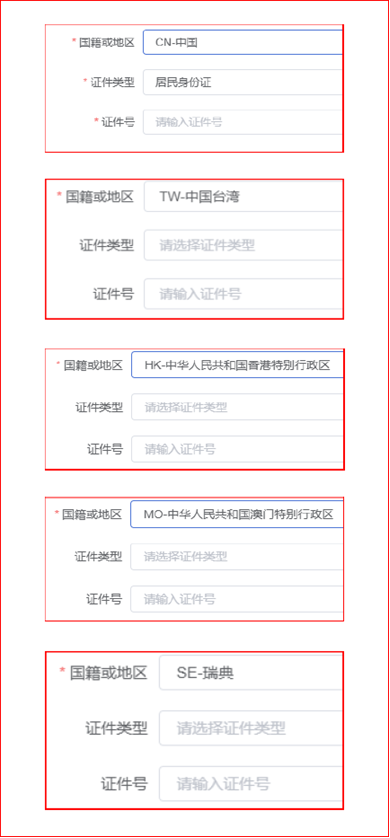
For inventors from Mainland China, nationality, ID type, and ID number are mandatory fields (marked with an asterisk*).
For non-Chinese inventors, as well as those from Hong Kong, Macao, and Taiwan regions, only nationality is a mandatory field (marked with an asterisk *). At the same time, ID type and ID number are optional fields (not marked with an asterisk).
Please refer to the screenshot below for details, where the first input is for mainland China with nationality, ID type, and ID number as mandatory fields (marked with an asterisk*). In contrast, the second input is for Taiwan, the third for Hong Kong S.A.R., the fourth for Macau S.A.R. and the fifth for Sweden, with ID type and ID number as optional fields (not marked with an asterisk).
This adjustment in practice is inferred to be a response to operational challenges encountered when handling cases involving non-Mainland Chinese inventors. Typically, such adjustments may be reflected in operational practices and would not involve further amendments to relevant laws or regulations.
Filed under: Insights