


Three Years of the Unitary Patent and UPC: What the Data Reveals
By Anders Heebøll-Nielsen | Posted on June 17, 2026

Three years after the Unified Patent Court opened its doors, the unitary patent system is taking shape in practice. This article looks at how the new options are used, where opt-outs are declining, and what the first wave of UPC activity reveals about Europe’s evolving patent landscape.
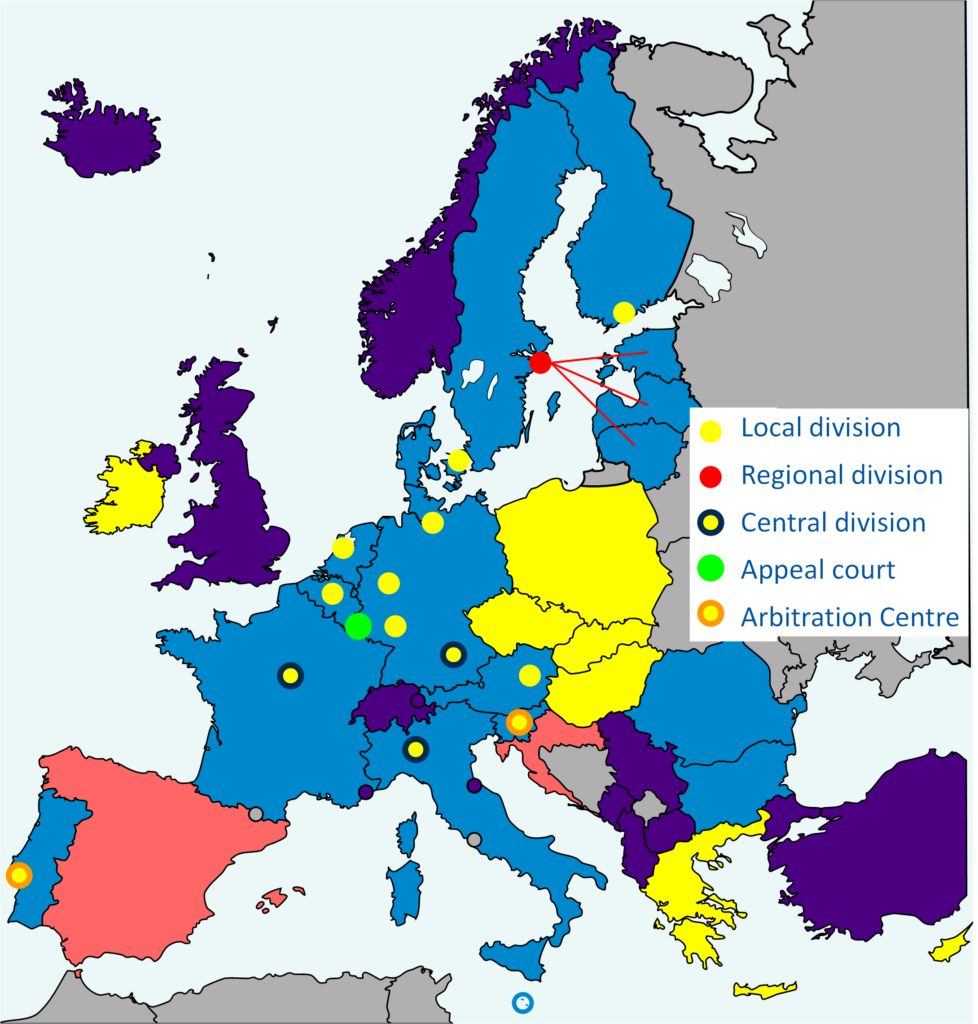
The Agreement on a Unified Patent Court (2013/C 175/01) was signed by 24 EU member states on 19 February 2013 (Figure 1), and on 1 June 2023, the Agreement entered into force. With the opening of the Unified Patent Court (UPC), unitary patents (UP) can be registered from granted European Patents (EP), and now, at the anniversary, we have three years’ of data on how stakeholders are using the options under Europe’s extended patent regime.
Figure 1 – Member states (blue) of the unitary patent system and locations of divisions of the UPC. Yellow states have signed the Agreement but have not yet ratified it. Red states have not signed the Agreement. Map Source: Wikipedia
Trends in UP registrations and opt-outs
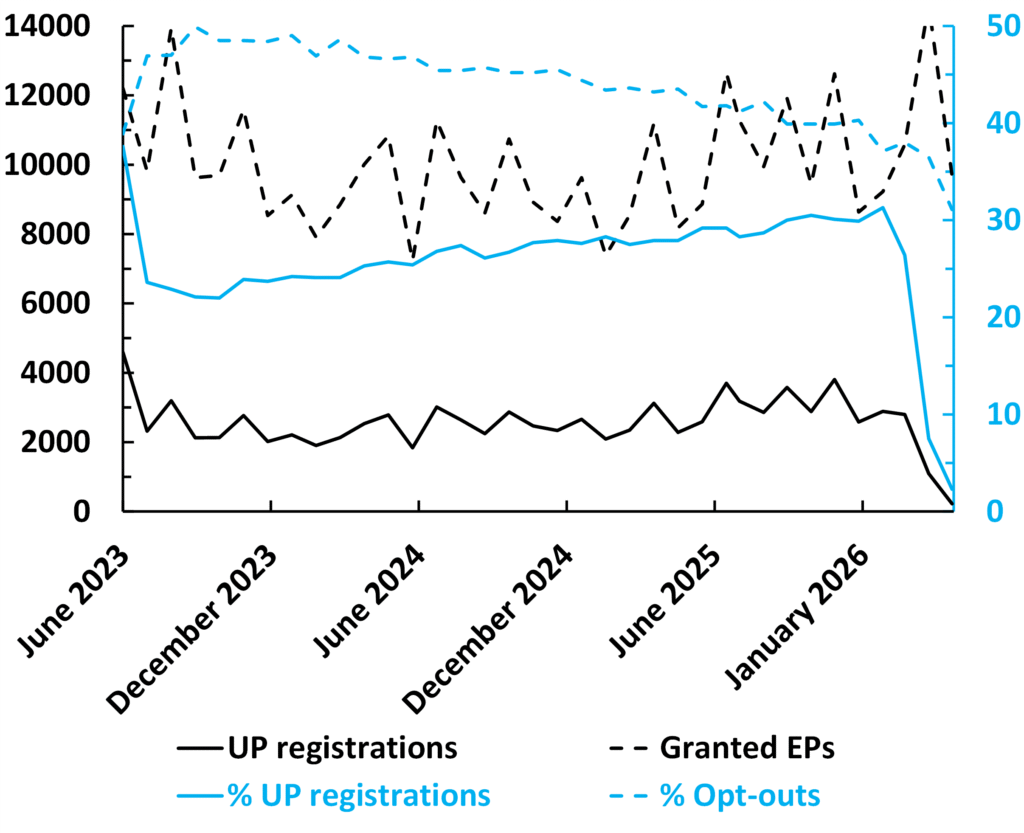
Figure 2 shows granted EPs and UP registrations, compares UP registrations to grants, and compares the number of opt-outs with the number of granted EPs.
From the German ratification of the Agreement, EP applicants could postpone the grant to allow registration as UPs. Figure 2 shows a high initial number of UP registrations, likely reflecting postponed grants. The drop in UP registrations in 2026 should reflect the time limit for registering a UP after grant and a delay in updating patent databases.
Figure 2 – Absolute numbers of UP registrations and granted EP, and relative numbers of UP registrations and opt-outs
EPs fall under the jurisdiction of the UPC, which has exclusive competence in cases concerning infringements and revocations, and corresponding counterclaims, whether they are registered as UPs or validated under the traditional procedure. However, under the Agreement, patentees can opt out of the UPC’s exclusive competence for European patents, so that cases are still to be handled by national courts where such EPs are validated.
Figure 2 shows a clear upward trend in UP registrations, while opt-outs show a downward trend. The drop in opt-outs suggests that patentees are beginning to accept the UPC, which may also be reflected in the increase in UP registrations.
IPCs, UP registrations and opt-outs
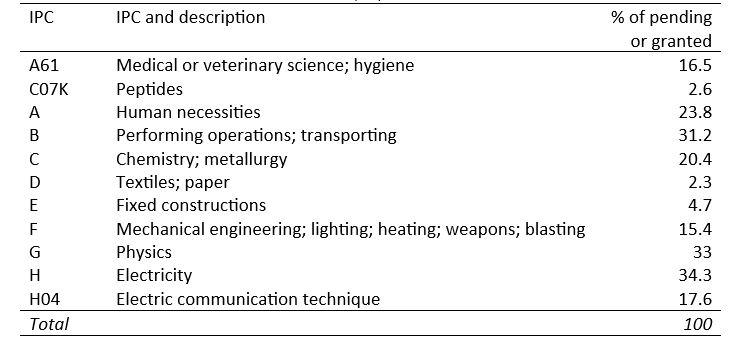
Table 1 shows the distribution of pending applications and granted patents across the eight sections and specific subdivisions of the International Patent Classification (IPC). A total number of ‘100%’ is included, although patents are normally classified in multiple sections across A to H so that the sections sum up to more than 100%.
Table 1 – Relative numbers of pending applications and granted patents according to international patent classification (IPC)
The value of a patent can depend on its technical field, and patents for medicines can be especially valuable. Prior to the entry into force of the Agreement, it was debated whether big pharma companies would prefer to avoid the risk of losing patents in UPC decisions and instead opt to litigate in national courts, i.e., opt out of their patents.
Figure 3 shows the relative numbers of opt-outs and UPs for each section of Table 1, normalised to the respective relative totals of opt-outs and UPs. For fixed constructions (IPC E), the proportion of UP registrations is very high, but IPC E is a relatively small section.
Figure 3 – Normalised distributions of UP-registrations and opt-outs
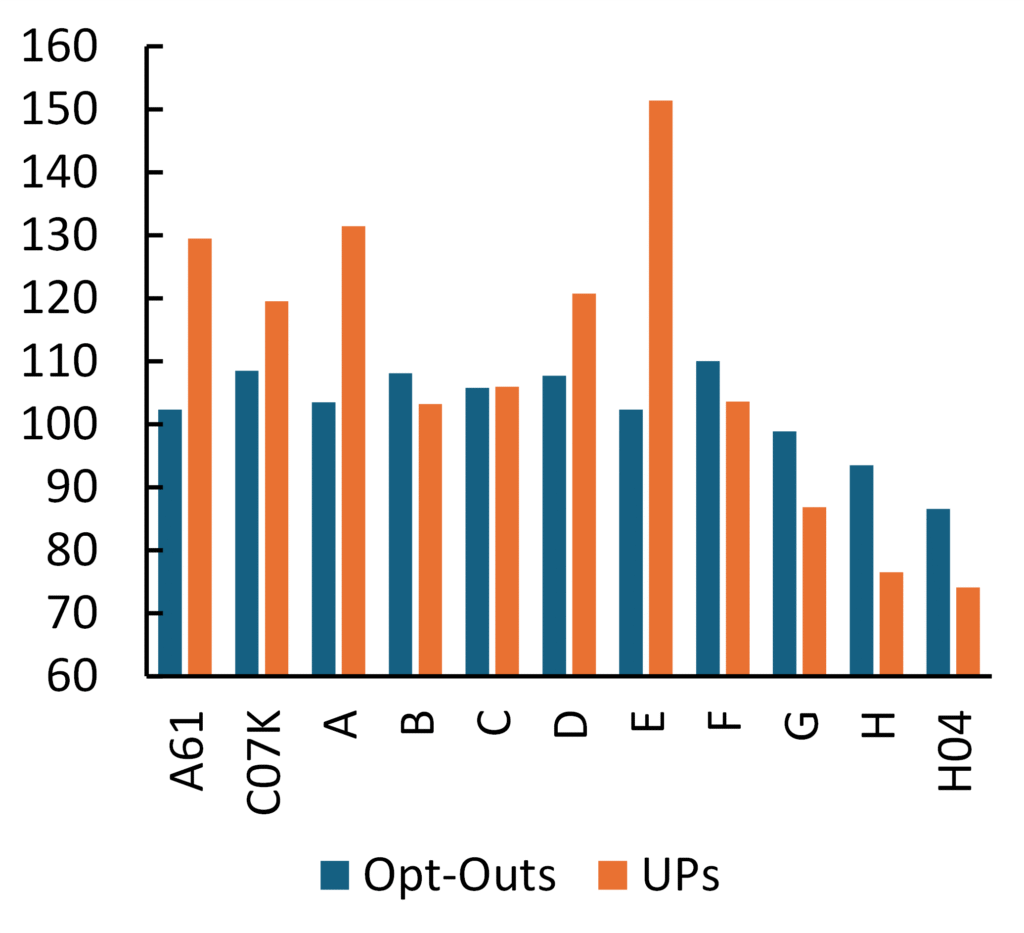
Section A, including subdivision A61, which should include most medicines, also has a higher proportion of UP registrations than the average for EPs. It appears that big pharma may accept the UPC’s decisions rather than national courts’.
Section H (electricity) has the smallest relative proportion of UP registrations but also the smallest proportion of opt-outs. Subdivision H04 is relevant to mobile electronic devices, and the proportions are even more extreme than for Section H. Apparently, patents in this section may create significant value even if they are in force in only a few countries.
Languages
There has always been a strong interest in simplifying the European patent system by reducing translation requirements, but also a correspondingly strong interest among member states in requiring translations into local languages.
A central concept of the UP system is set out in EU Council Regulation 1260/2012 on translation arrangements, which provides that, during a transitional period, a full translation of an EP must be provided upon registration of a UP. Table 2 summarises the languages used to register UPs. An English translation is required for EPs granted in German or French, and the percentage of English translations closely matches the share of French and German as procedural languages at the European Patent Office (EPO, see Table 5).
Table 2 – Languages used to register UPs
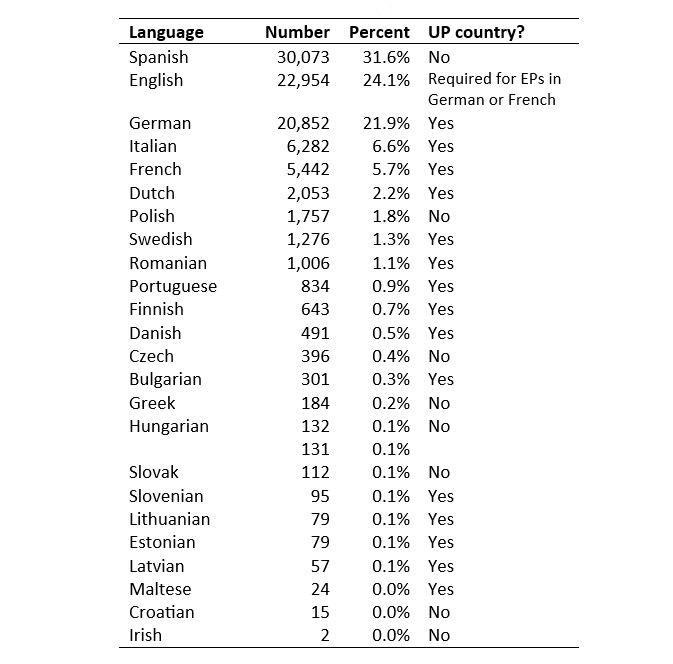
The languages used for UP registrations may reflect that certain EPs are translations of priority applications, but while Spain is not a UP country, Regulation 1260/2012 allows that any other official language of the EU is used for a UP registration, so that with a Spanish translation, an EP can also be validated in Spain at little extra cost. This is a likely reason for Spanish being the most common language in UP translations. The 131 UPs registered without a translation should reflect that the translation can be filed up to one month after UP registration and thereby represent UPs awaiting the filing of a translation.
Table 3 – Percentage validations before and after UP entry into force
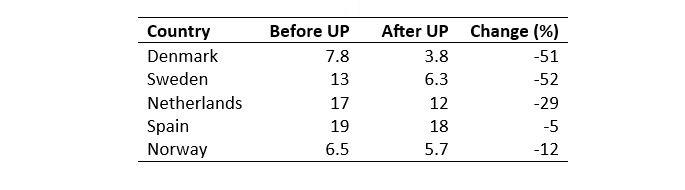
An EP cannot be validated in a UP country if the EP has been registered as a UP. Table 3 compares the percentage of EPs validated in a few select countries before and after entry into force. Thus, “Before UP” shows numbers for 2020-2022 and “After UP” shows numbers from June 2023.
Evidently, only half as many EPs are now validated in Denmark and Sweden as before the Agreement’s entry into force, and a significant decrease in validations is also observed in the Netherlands, whereas Spain and Norway have seen much smaller drops.
Activity at the UPC
Table 4 shows the numbers for common case types at the UPC (as available from the UPC website) and oppositions at the EPO. As expected, infringement actions constitute the major activity at the UPC, whereas only a few revocation actions are filed, especially compared with the number of opposition cases filed at the EPO.
Table 4 – Case types filed at the UPC and oppositions at the EPO.
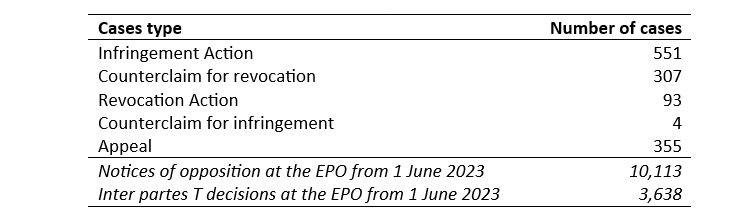
Infringement cases often lead to counterclaims for revocation, but only a small fraction of the revocation cases have led to counterclaims for infringement. If a counterclaim is considered to be the ‘same’ case as the case that provoked the counterclaim, more than half the cases filed at the UPC have been appealed. With this, consultants should be prepared when advising a client: if a UPC case is filed, expect an appeal case.
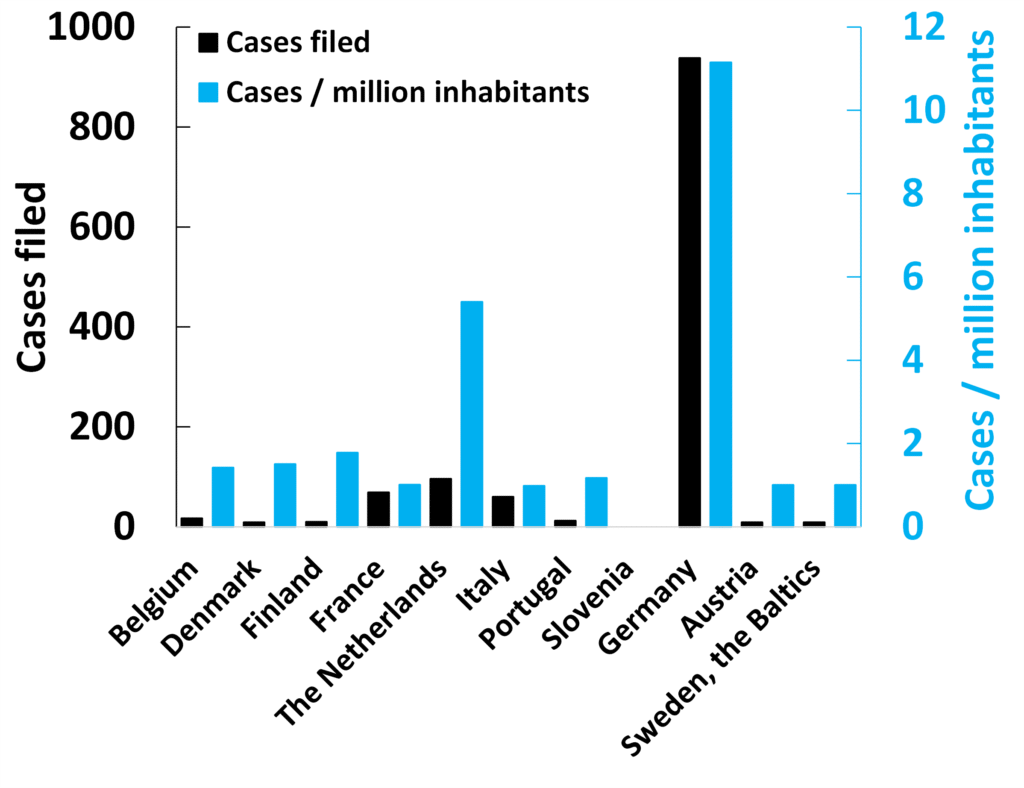
Infringement actions are typically started at a local division of the UPC (see Figure 1), and Figure 4 shows the number of UPC cases in each UP country. For comparison, Figure 4 also normalises the case numbers to the population sizes in the UP countries. Germany has always been a hot spot for patent cases, which is highlighted in the normalised number. The Netherlands have also attracted many patent cases, whereas the normalised numbers for the remaining countries do not deviate much.
Figure 4 – Cases filed at local divisions and number of cases per million inhabitants
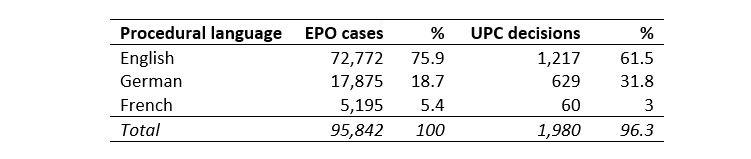
UPC cases are not limited to the languages of proceedings at the EPO and can commonly be filed in the language of the local division. Nevertheless, more than 96% of the UPC decisions have used one of the languages of the EPO, as shown in Table 5. However, as may be expected from the number of UPC cases in Germany, German carries much more weight at the UPC than at the EPO. With this in mind, a future focus for attorneys could be German language capabilities.
Table 5 – Procedural language at EPO and languages of UPC decisions
Naturally, since the start of the UPC, case law has been developing, and Table 4 includes the number of appeal cases at the UPC and, for comparison, also the number of inter partes T decisions published by the EPO from 1 June 2023.
In light of how both EPO opposition cases and T decisions far outnumber revocation and appeal cases, respectively, at the UPC, it will be interesting to follow the evolution of how the UPC evaluates inventiveness compared to the problem and solution approach of the EPO and especially how much weight the UPC opinions can have in EPO cases.
Disclaimer
The numbers in this article were obtained in the first week of June 2026 from the EPO Register, including its Statistics & Trends Centre, PatBase, and the UPC website. However, considering the dynamic nature of online databases, the numbers may look different on another date.
Filed under: Insights