


Why you should pursue patents in the clean beauty sector
By Ylva Strandberg | Posted on January 20, 2026
Clean beauty is growing rapidly with cosmetics made with non-toxic, safe, and sustainably sourced ingredients. Driven by consumer demand for transparency and wellness, it emphasises ingredient clarity, ethical practices, and eco-friendly packaging to build consumer trust.
Clean beauty is a significant market for brands prioritising health and environmental responsibility. The European clean beauty market was valued at USD 2.50 billion in 2024 and is expected to grow at a 13.81% compound annual rate from 2025 to 2033, reaching USD 9.67 billion by 2033 from USD 2.84 billion in 2025, according to Market Data Forecast.
In addition to brand protection through trademarks, patents can help companies protect innovative clean beauty products, differentiate their products from competitors, and establish market presence.
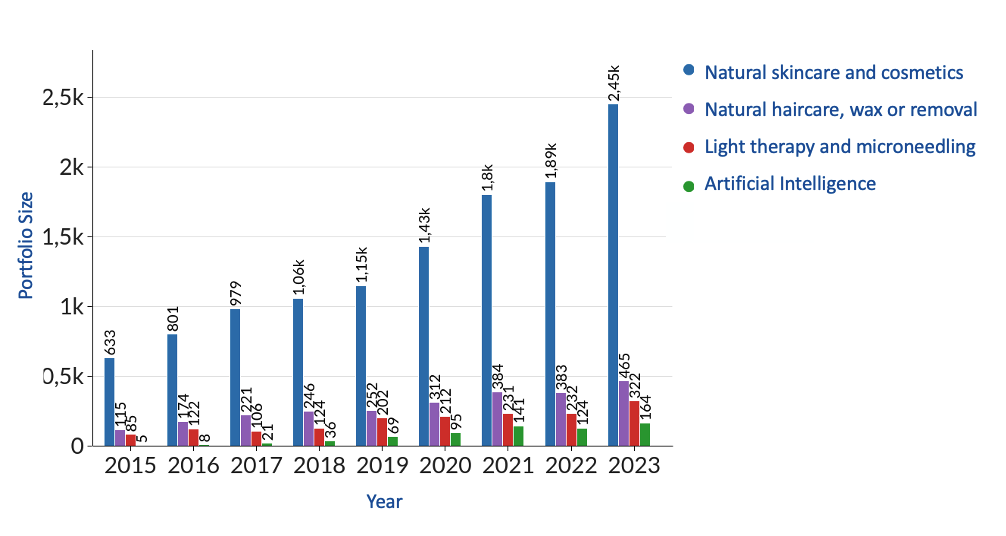
There has been an exponential increase in the patent portfolios of clean beauty brands over the past eight years, as seen in the graph below, compiled using data from PatBase and PatentSight:
What can a patent provide?
Patents provide the exclusive right to commercialise your idea or invention for 20 years and protect against others manufacturing, selling or importing it without permission.
Including wording such as “patented” or “patent pending” on product packaging can deter potential imitations and attract consumers who see it as a seal of quality. There are several examples of this, with the science-based beauty brand Augustinus Bader utilising “TFC8® is our patented and formulated technology backed by over 30 years of research” and Codex Labs “Made with our patent-pending, potent BiaComplex® 2.0 formula, this lotion for face, hands, and body deeply re-hydrates and is clinically proven to soften, smooth, and restore skin barrier integrity.”
Patents can also help attract investors, even during the patenting process, by showing that you have a granted patent or a “patent pending”. It also opens up the possibility of licensing agreements that can provide companies with new sources of income.
What can be patented in clean beauty?
Various innovations can be eligible for patent protection in the clean beauty sector. This includes unique ingredients and formulations that offer enhanced moisturising or rejuvenating effects, as well as those that help reduce redness or pigmentation.
Production processes that improve product quality or yield are also patentable, provided they are novel and non-obvious. Additionally, environmentally friendly packaging solutions that enhance product durability or stability can be patented.
Lastly, novel delivery systems designed to facilitate better penetration of active substances into the skin are also eligible for patent protection, provided they meet the criteria for novelty and inventive step.
Clean beauty patent examples
Some examples of patent applications within clean beauty include:
- ASC Regenity Ltd (UK), inventor Augustinus Bader – “Cosmetic formulation for topical administration comprising novel peptides that improve appearance and regeneration of skin”, reference to the TFC8® complex (WO2021148241).
- Neopharm Co Ltd (KR), “Anti-aging composition” to a stable composition that reduces wrinkles and improves skin elasticity through the composition’s ability to stimulate collagen production (EP3431082 B1).
- Bionorica SE (DE), “Cosmetic compositions comprising cannabidiol (CBD) and zingiber extract”, for the treatment of inflammatory conditions such as eczema (WO2023046730A1).
As consumer expectations around safety, sustainability, and transparency continue to rise, securing patents in the clean beauty space is an excellent strategic move.
By protecting novel ingredients, formulations, processes, packaging, and delivery systems, brands can safeguard their innovations, stand out in a crowded marketplace, and build long-term value.
Whether you are an emerging startup or an established cosmetics company, now is the time to consider how patents can support your growth.
Filed under: Insights